Field noteJune 10, 20264 min readSankritya, co-founder
The doc you wrote once is already lying to your agent
Access was never the problem. Freshness is.
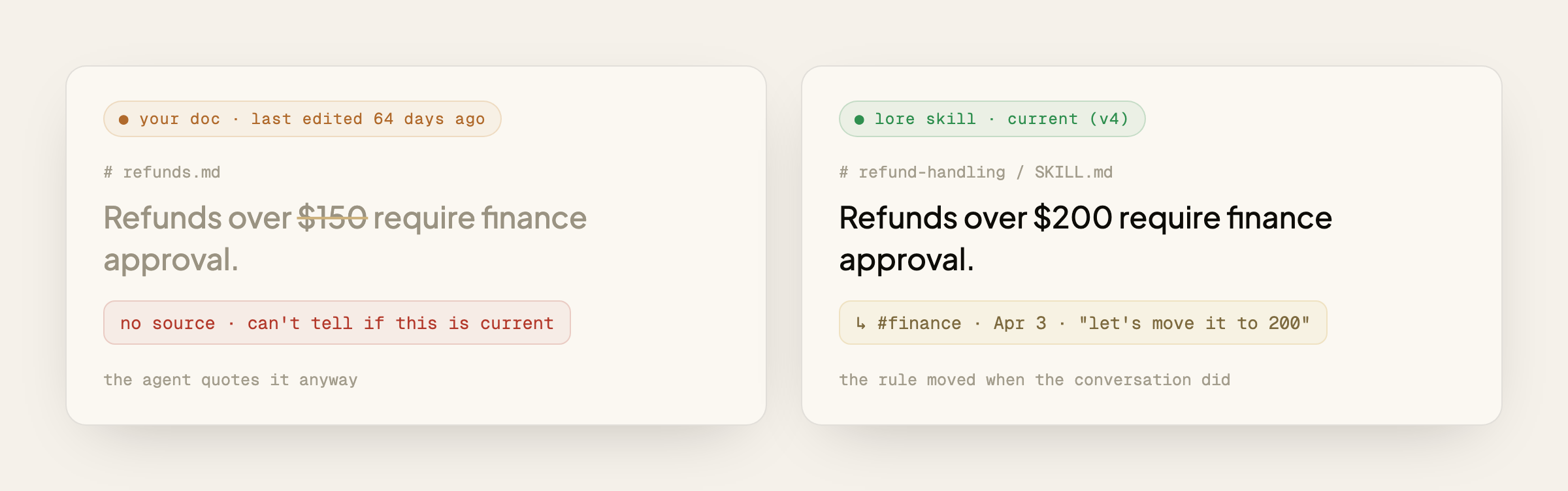
Give the agent access to your Notion, people say, and it will know how your company works. We believed that too, for about a week. Then we watched an agent confidently quote a refund rule we had changed two months earlier. The doc was right there in the workspace. It was also wrong.
The doc was not lying because anyone lied. It was lying because it was written once, in a moment that has passed, and nothing has updated it since. Every document your company owns is a photograph. Your company is a film.
Access solves the wrong problem
Most agent setups treat knowledge as a retrieval problem. Point the agent at more sources, embed more pages, widen the net. That gets the agent more text. It does not get it more truth. A confidently retrieved stale policy is more dangerous than no policy, because the agent has no way to know it is holding last quarter's rule.
The real decision did not stay in the doc. It moved. It moved into a Slack thread where someone said let us bump the threshold, into an email where finance signed off, into a call nobody wrote down. The doc is often the one place the current answer is guaranteed not to be.
Freshness is a provenance problem
You cannot fix staleness by refreshing more often. You fix it by making every rule carry a citation to the exact message that set it, so the rule can be checked against its source before an agent acts on it. If the source moved, the rule is stale, and you can see that it is stale. No citation, no trust.
What we changed
Lore does not keep a copy of your doc. It reads where the decisions actually happen, Slack and Gmail and Notion, and derives the rule with a citation on every line. When the underlying message changes, the rule re-derives, and the old one is kept and marked superseded for audit. The agent is never holding a photograph. It is holding the current frame, with a link back to where it came from.
We run this on ourselves. Three skills, refund-handling, incident-response and pricing-exceptions, every clause clickable to the message that decided it. When we change how we do something in Slack, the skill changes. That is the product in one sentence: the policy follows the conversation, not the other way around.
A document is a promise someone made once. A cited skill is a promise the source keeps making.
We are early, in YC-review build, onboarding the first design partners by hand. But every week makes the bet feel more right. The next leap for agents is not more access or a bigger model. It is knowing that what they know is still true.
If your agents are quoting documents nobody has opened in a quarter, that is the conversation we want to have. We are building this in the open.